




















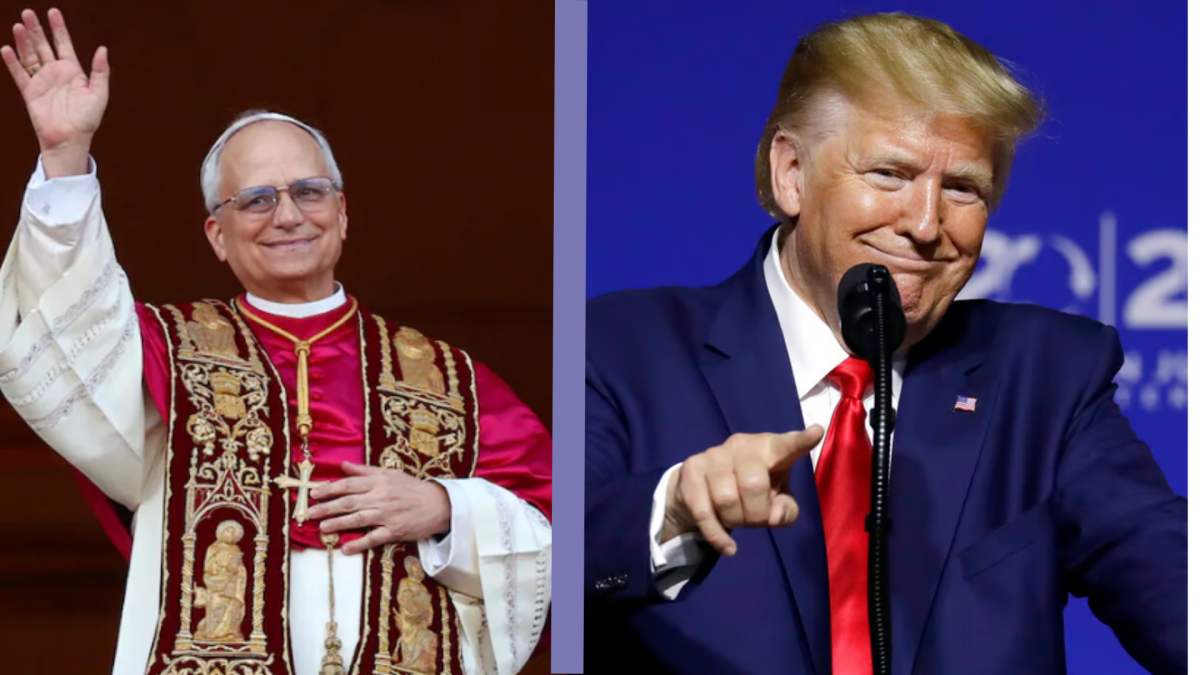
Pope Leo XIV has recently faced criticism for his remarks on Trump and the way the U.S is handling the war in Iran. At St. Peter’s Basilica on Palm Sunday, the Pope gave a message about peace. “God rejects the prayers of those who wage war,” he said. “Enough with the idolatry of self and money! Enough with the display of force! Enough with war! True strength is manifested in serving life.” Even though the Pope did not mention Trump specifically in this address, he had previously criticized Trump’s threat to destroy Iran.
Trump supporters quickly responded. “I was taken a little bit aback,” Mike Johnson, Speaker of the House of Representatives, said.
Even Vice President JD Vance, who is a Catholic, said, “I think it’s very, very important for the Pope to be careful when he talks about matters of theology.”
Carrollton’s school chaplain Father Vallee believes Vance should not be saying things “that are just wrong as a Catholic.” He thinks that while the politicians have every right to disagree with what the Pope says, they should not disregard his comments.
He talked about the delicate balance between church and state in the United States. “In America, there’s explicitly a separation of church and state, which says that the church is allowed to comment, but religion shouldn’t determine politics, and politics shouldn’t determine religion either,” he said.
One of the questions that politicians and religious leaders are debating is what constitutes a “just war.”
Trump defended his actions by pointing to Iran’s history of oppression and violence. “Will someone please tell Pope Leo that Iran has killed at least 42,000 innocent completely unarmed protesters in the last two months and that for Iran to have a nuclear bomb is absolutely unacceptable?” he said.
Fr. Vallee acknowledges that some wars are just. However, according to the Catholic Church, there are specific criteria to meet in order to have a just war: St. Thomas Aquinas developed this theory in the 13th century: “The damage caused by the aggressor must be understood as lasting and serious with concrete evidence. All other means of ending the conflict must have been exhausted, [and] there have to be serious prospects of success. Proportionality must be considered as the use of force mustn’t produce evils that are worse than the evil they are trying to eliminate.”
When Catholics consider whether wars are just and choose to speak out against political or religious leaders, they need to consider all these factors.
Although disagreements will inevitably occur, Pope Leo urges world leaders to do everything possible to pursue peace. “We have different beliefs, we have different ways of worshipping, we have different ways of living,” he said. But he still believes “we can live together in peace.”


Liana León • May 15, 2026 at 1:27 pm
i love this! super interesting!