





























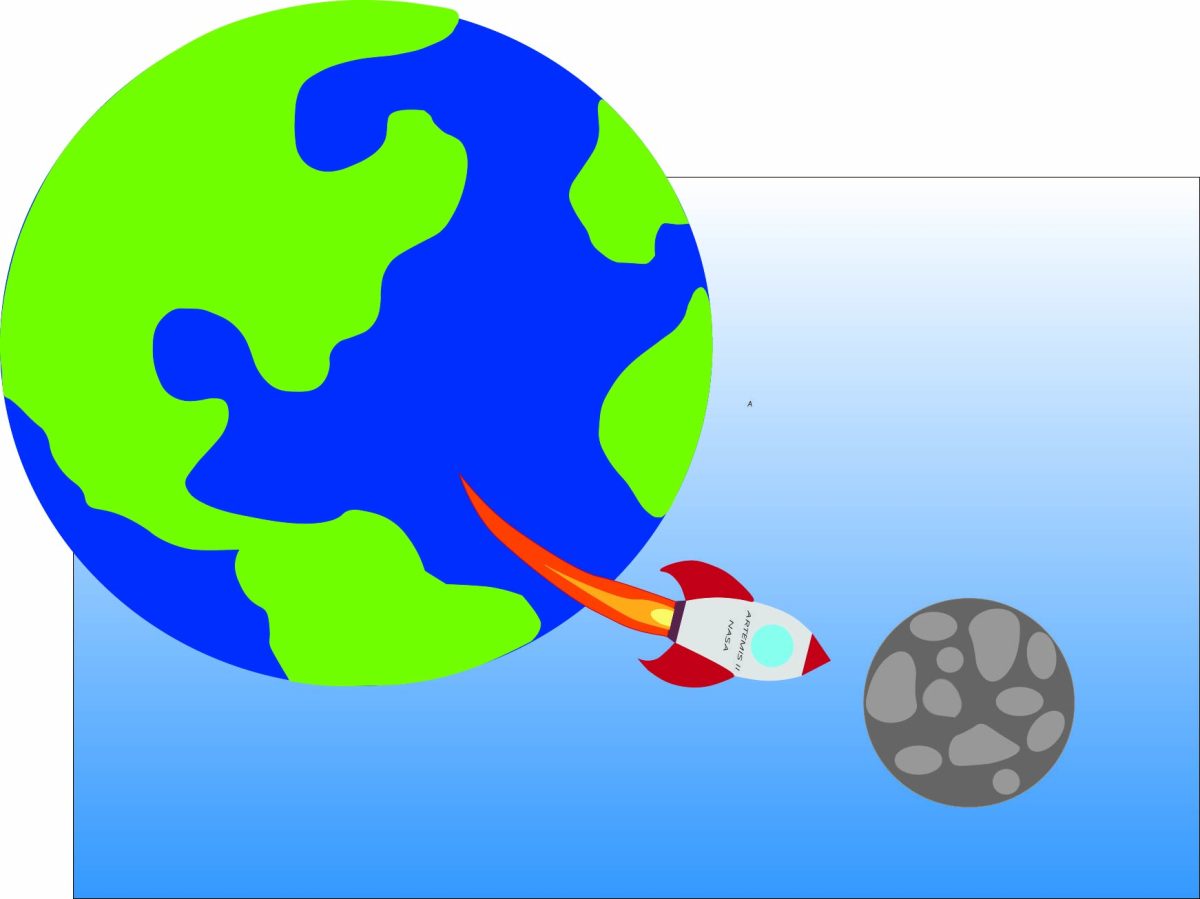
For the first time in more than 50 years, humans are preparing to travel back to the moon as NASA’s Artemis II mission gets ready to launch.
The Artemis II mission was originally planned for November 2024, but was delayed until early 2026, then delayed again from March until April of this year due to technical issues. This mission includes Christina Koch, who is the first woman to fly on a mission to the moon. Victor Glover, also on this mission, will be the first black astronaut on a lunar mission.
NASA’s return to the moon will help us learn more about space, test new technology for trips to Mars, and provide valuable resources. Scientists also hope this return will inspire the next generation to study science and technology.
According to PubMed Central, humans have a natural desire to explore.
Upper School science teacher Ms.Thome agrees and hopes that this desire will help make life here on Earth better. “Humans naturally want to explore, and building a base on the moon helps us learn new things that improve life on Earth like creating new materials and growing plants more efficiently,” she said.
Even though she is excited, she believes that Earth should remain the center of attention. “We can focus on both, but there’s still a lot to fix on Earth,” she said.
In addition, she worries that the environmental problems we face here will be an ongoing issue in space. “Waste is also a problem in space, and I worry we’ll repeat the same mistakes, so we need to protect new places and not leave trash behind.”
Overall, though, she is positive about the mission. “It’s a big project that I think is hopeful and very interesting,” Ms. Thome said. “I’m excited because this is just the start of exploring new possibilities. Researchers, including [those at] the University of Florida, are studying lunar regolith from three different sites. They’re figuring out how to grow plants on it for sustainable food and how to extract useful minerals like iron, potassium, manganese, and copper.”
Intermediate science teacher Mrs. Gomez also believes this mission could be helpful, as past missions have already improved our lives on Earth. “We wouldn’t have many of the things that we have today, such as the ability to track weather and climate [without space exploration],” she said, “so who knows what other tech there could be that we would later find essential?”


Mila Andrea Shanley • Mar 12, 2026 at 12:23 pm
Very gooooood
Liana León • Mar 12, 2026 at 12:23 pm
Wow! So amazing!!