




























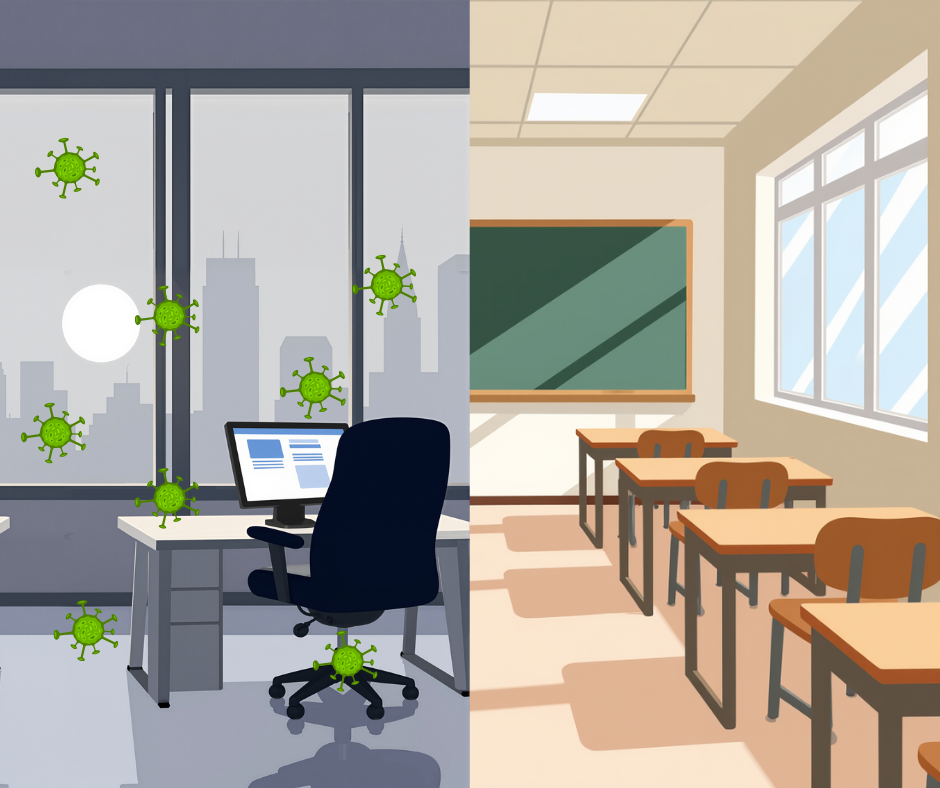
To many people, it feels like yesterday that we were all staying inside, wearing face masks, attending classes over Zoom, and keeping a 6-foot distance between friends. However, the Covid-19 pandemic and quarantine were almost six years ago. Even though more than half a decade has passed, the impact on education remains a significant topic that affects teachers and students today.
At Carrollton, the quarantine began in the middle of March and lasted for the rest of the 2019-2020 school year and into the 2020-2021 school year. On average globally, schools were closed for 5.5 months, but some schools stayed closed for longer. Though this may not seem like a long time, these five and a half months heavily altered student life, the school environment, and education as a whole.
As classes moved online, families and schools quickly had to adapt to new technological practices, which has led to a larger adoption of technology use in education today. Remote learning introduced personal technology devices as the standard way of learning, which allowed students and teachers to connect easily at home. Students also experienced a rise in the use of learning management systems (LMS) like Google Classroom. These LMSs assisted in organizing course work and are still utilized today.
However, this reliance on technology has had some detrimental effects on student progress and performance. According to the Annie E. Casey Foundation, in 2022, only 26% of eighth graders were at or above proficient in math, down from 33% in 2019. As the reading and math scores began to drop after the pandemic, the gap between low and high performing students widened. As a result, many schools have implemented learning blocks to accommodate different learning styles, provided more individualized support, and provided more small-group work.
“I struggled to actually listen in class,” said Grace Purkis ‘28. “Even though it was five years ago, I remember always looking out my window and not paying attention. And It’s definitely still present today. I always need to force myself to focus.”
In addition to the many setbacks in education, educators and psychologists noticed a rise in depression and anxiety in students. This could be attributed to the increase in isolation, larger amounts of screen time, and less physical activity. Purkis was one student who felt this mental toll. “Covid was hard because I spent such a long time without seeing my friends. It was nice to be able to call them on Zoom or Facetime, but it definitely wasn’t the same from seeing them every day to never seeing them in person,” she said.
To address mental health issues, many schools and teachers now spend more time on activities that focus on students’ social-emotional well-being. They address behavioral issues earlier and have hired more counselors and social workers to provide constant support for students.
In the end, school administrators have made large advancements in recovering from the pandemic. Despite these advancements, schools will need to continue promoting different programs aimed at the many problems that have resulted from COVID-19 and quarantine.