

































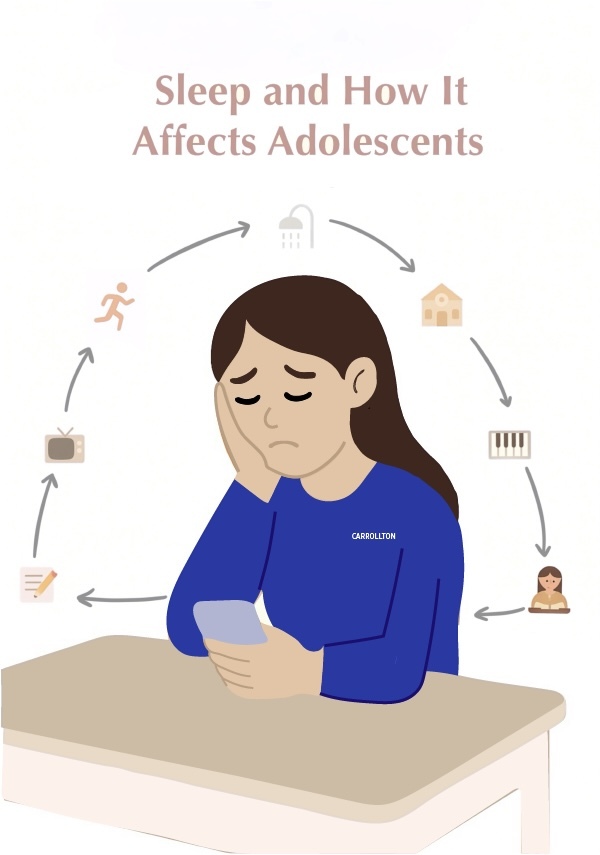
Picture this: a teenage girl wakes up at 5:45 a.m. for morning running practice. She gets back home at 7:45 just in time for a quick shower and breakfast before she grabs her bag and rushes to school, which starts at 8:30 and isn’t over until 3:30. At 4:30, after a quick snack, she has piano lessons followed by tutoring at 6. When she finishes at 7, she does the rest of her homework for the next day, which takes her until 10. She has a small dinner and gets in bed wanting to relax after a busy, tiring day, so she watches a movie and falls asleep at 12:30 a.m, knowing that she only has about five hours to sleep before she has to wake up again and repeat the cycle.
Sleep is one of the most critical components of health for humans, but especially for developing adolescents who spend their jam-packed days doing all types of activities that exhaust them physically and mentally. So why is sleep so important for teenagers, and how does it affect their performance?
According to Johns Hopkins Children’s Hospital, sleep is the source of repair for the body. It can prevent infections and rebuild muscles. Mentally, sleep helps with focus and mood swings.
The stage of adolescence is marked by “dramatic maturational changes in sleep and its neurobiological regulation, hormonal status, and many psychosocial and physical processes,” meaning that sleep plays an important, yet complex and overlooked role in the mental and physical health of developing adolescents by regulating hormones and playing a major part in maintaining homeostasis. Studies have found that lack of sleep or changes in sleep patterns of teenagers may trigger “many psychiatric and physical disorders or combinations of these conditions, which presumably hinder recovery and may cross into later stages of life.”
So, how does the amount of sleep teens get correlate to how they perform in their academics and extracurriculars? According to experts, sleep promotes attention, memory, and analytical thought. It sharpens thinking by helping the brain recognize only the most crucial information to consolidate learning. Sleep also facilitates thoughts that can trigger creative flow.
Without sleep, the Child Mind Institute states that adolescents are at an increased risk of injuries, develop the inability to self-regulate themselves, and are more likely to abuse substances and engage in risky behaviors. Sleep deprivation may also lead to mental illness and increased mood swings in teenagers.
Even though sleep is undeniably important, studies show that sleep deprivation and changes in sleep patterns are becoming more common amongst teenagers in the United States, where 60 – 70% of adolescents live with borderline to severe sleep debt. Because teenagers are still developing and cannot always fully grasp the consequences of their actions, they may not understand that their lack of sleep truly affects them in all aspects of their lives. Many teens do not think about the fact that sleep can help them be less distracted when studying for a test, concentrate more when learning an instrument, or even keep their cool when nervous before a school soccer game.
The importance of education for teens is evident, and the role it plays in their future and development into adulthood is vital, especially with the rise of artificial intelligence and other factors changing the way teenagers learn and how much information they absorb. But sometimes academic pressures add to their already stressful lives instead of fostering positivity and knowledge. Adolescents in the 21st century feel they are not allowed to fail because competition with peers and pressures of getting into a top-rated college are so present in their lives. Sleep deprivation becomes the norm, even if most are aware of the dangers of it, because they feel as though they have no choice but to pull an all-nighter to pass their AP, IB, or dual enrollment courses. Then, they still end up failing because they got no sleep the night before their big exam.
Solutions to this problem exist, but are difficult to implement when adolescents are faced with the pressure to do both things — succeed academically and maintain a healthy sleep schedule. One solution, which research shows is effective, is for schools to provide “sleep education curriculum including time-management training.” They must teach students about the disadvantages of sleep deprivation rather than just tell them to go to sleep earlier. In one school that adopted these strategies, students functioned much more effectively.
Another possible solution to this issue is postponing school start times until later in the morning, as studies have concluded that disrupting teenagers’ sleep cycles by forcing them to wake up early for school was a massive factor in sleep deprivation and insomnia.
Ultimately, prioritizing sleep over anything else in life is an important, but difficult concept that adolescents need to grasp in order to truly function to their fullest potential and stay healthy.


Andrea Diaz • Nov 13, 2025 at 1:23 pm
This was very informative!
Michelle Vigoa • Nov 13, 2025 at 12:29 pm
This is a great article ! As part of the AP Psychology course, we look into sleep, its benefits, and how our sleep cycle works. Your suggestion for “sleep education curriculum including time-management training ” is excellent. Educating our girls on the importance of sleep and techniques on how to manage their time is crucial if we want to holistically educate our students. Another element that could be written about is the importance of dreaming while we sleep. I am here if anyone is interested in learning more about this and writing about it in future articles. Great job Cata !!!
Diana Sudasassi • Nov 13, 2025 at 8:47 am
This is a great article – well written and much needed! Overscheduling is a big contributor to lack of sleep, and recognizing this is half the battle.