





























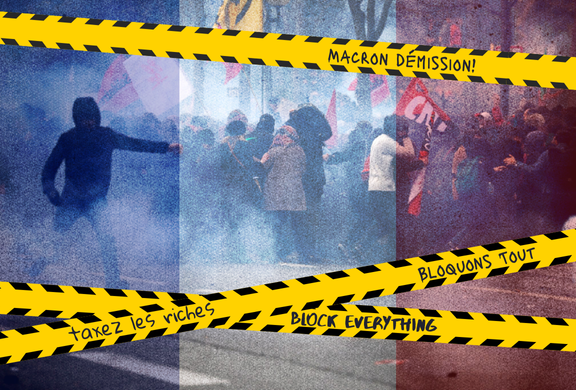
An upturned bus in flames, severed electrical cables spewing sparks, streets clouded with tear gas and smoke. These were just some of the scenes in France following Sébastien Lecornu’s turbulent first days as prime minister, the country’s fifth in less than two years.
On Sept. 8, former Prime Minister François Bayrou was ousted from power after losing a vote of no-confidence in the National Assembly. Bayrou’s downfall came after his deeply unpopular proposal to slash €44 billion ($52 billion) from public spending in the 2026 budget.
The plan included freezing pensions, raising healthcare costs, and scrapping two public holidays, all in an effort to curb France’s mounting deficit, which sits around 5.8 percent of GDP, nearly double the European Union’s 3 percent limit.
Critics argued that this plan shielded the wealthy while burdening ordinary citizens, pointing to Macron’s earlier corporate tax cuts and rollback of France’s wealth tax.
Anger over these policies and proposed budget cuts boiled over in a grassroots movement known as the “Bloquons Tout” or “Block Everything” movement, a coalition of unionists, students and workers. The movement originated on social media, but it began attracting widespread attention in the summer and quickly evolved into a nationwide protest movement, demanding economic justice and government accountability.
On Sept. 10, the movement had its first physical display of protest. Across the nation, protesters obstructed highways, set fires to brigades, and clashed with the police. This somewhat radical show of civic disobedience reflects the greater sentiment in France that the government is out of touch with its people.
More than 80,000 officers were deployed as protests escalated, echoing the Yellow Vest movement that once shook Macron’s presidency.
Algawen Vega, a protester in Paris, a nurse, and a union delegate for the public hospital, reflected this sentiment when she said, “We’re governed by robbers. People are suffering, are finding it harder and harder to last out the month, to feed themselves. We’re becoming an impoverished nation.”
After Bayrou’s ousting, President Emmanuel Macron was quick to appoint Sébastien Lecornu, a loyal ally and the former defense minister, to restore order. Lecornu’s arrival at Matignon Palace was meant to restore order, but it instead exposed the depth of France’s political fracture.
Within weeks, protests intensified, the markets wobbled, and Lecornu briefly offered his resignation on Oct. 6, citing an inability to govern amid chaos. Macron refused to accept it.
Days later, Lecornu was re-appointed with a reshuffled cabinet and a vow to rebuild trust. Intending to ease tensions in the National Assembly, he pledged not to use Article 49.3, a controversial constitutional tool allowing governments to bypass parliamentary votes.
Even so, Lecornu faced two no-confidence motions on Oct. 16 (one from the far-left, one from the far-right) after making major concessions, including suspending a landmark pension reform. Both motions narrowly failed, granting the prime minister a fragile reprieve and keeping Macron’s minority government alive, for now.
However, the crisis is far from over as France’s fiscal situation remains dire. Lecornu’s revised 2026 budget aims to cut roughly €30 billion, trimming the deficit to around 4.7 percent of GDP, still above EU limits. Opposition parties on the left and right alike have vowed to block the plan, calling it “class warfare in disguise.”
Meanwhile, the “Block Everything” movement continues to mobilize. On Sept. 18, hundreds of thousands joined a national strike against austerity, crippling transport networks and forcing schools, hospitals, and public offices to close. Arrests have surpassed 1,300, and police unions warn that morale is plummeting amid nightly confrontations.
With public confidence eroding, Macron faces growing calls to dissolve Parliament, or even step aside if his government cannot restore stability. The left-wing Socialist Party has even threatened to topple the government unless their budget conditions are met.
The president has insisted that “order and progress will return,” but outside the Élysée Palace, the chants of “Macron démission!” (“Macron, resign!”) tell a different story.
For now, France teeters between governance and gridlock. Lecornu’s survival bought the president a little time, but the deeper crisis of inequality, frustration, and democratic fatigue shows no sign of easing.
Whether the government can pass its budget, calm the streets, and convince the public that its sacrifices are shared fairly, will determine not only Lecornu’s future, but the country’s.



Ms. Stojsic • Nov 12, 2025 at 8:16 pm
Thank you for reporting this story in Western Europe. I want the situation to be better for people there.
Bella Guitian • Nov 12, 2025 at 12:59 pm
Awesome article!