

















“The wisdom of God is fiercer than a cloudburst/greater than the heavens/deeper than the sea…”
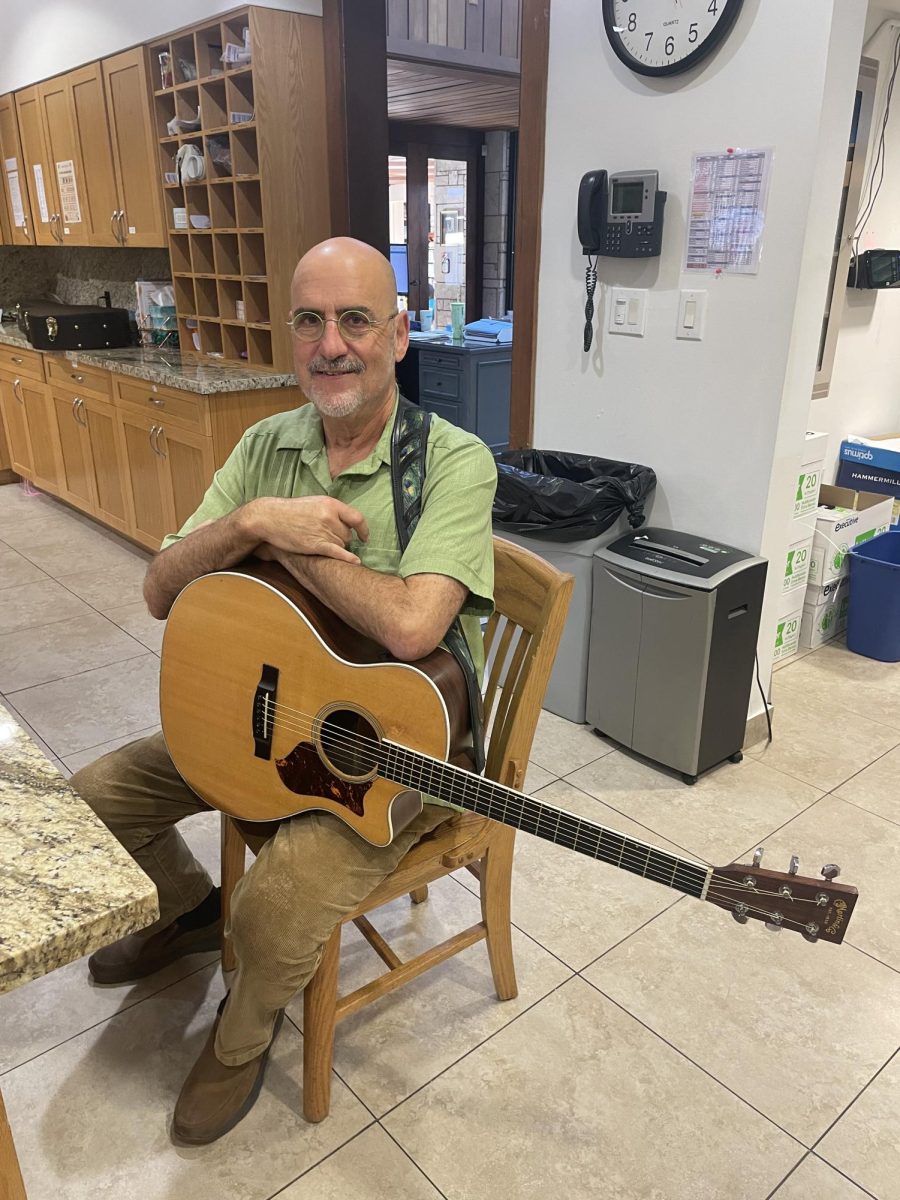
Every Mass, Carrollton chaplain Father Vallee slings his guitar strap over his shoulder and passionately shares his original songs. Whether it is through clever lyrics or hand motions, they provide entertaining engagement with his homily. Through his songs, Father Vallee meticulously connects religious messages and music. But what is his writing process? What inspires him? Father Vallee sat down for an interview to share his love for and journey with songwriting.
The following interview has been edited and condensed for clarity.
When did you start writing?
I first began writing very early when I was in college. I have played guitar all my life; since I was little, I took lessons, but it was in college when I started writing for liturgy, for religious stuff. I have a great love, not just for music, but for words. I love words. I didn’t really start writing music. I started writing poetry. That’s eventually music.
What inspired you to start writing?
Nothing did but my sheer love for words. I just loved them. I’ve always loved poetry. I’ve always loved literature. When I was in sixth grade, I read “The Hobbit,” and it made me fall in love with reading. I totally loved it, so I read, read, read. I think I started writing poetry and music for nothing else but sheer love.
What songs and artists inspire you?
There are quite a few. My two favorite popular composers are Bob Dylan and Leonard Cohen. Cohen is a Canadian musician who wrote the song “Hallelujah.” I probably love Cohen for the same reason that I loved music in the first place. Cohen was not a very good musician to start with. He got better at the end, and was, eventually, a great musician. But the words are glorious. They’re just beautiful. With him, it’s the same thing as me. His real love was not so much melody and harmony, it was lyrics. When it comes to more classical composers, I’ve always had a real affection for Mozart because unlike Dylan, where it’s all about the lyrics, with Mozart, it’s just about the music. It’s just beyond good. They say he thought of music differently. So when Mozart heard the C chord, he saw the color yellow. When he heard a B, he saw the color blue. He processed music in a whole different way and that makes his music so great. Even today, his music is a little ahead of its time. Certainly, for his own time, it was unimaginable.
What is your favorite song and why?
There’s a song by Bob Dylan that I love called “Stuck Inside of Mobile with the Memphis Blues Again.” I love songs that are deep and profound. I like Dylan’s songs because they can be funny. I like paradoxes. There are always these funny little plays on words that make a joke. I love songs that do that.
What is your songwriting process?
I start with words, words, words. So I write lyrics first. Sometimes, I’ll go to scripture for those words. After I’ve written the words, I find chords somewhere that’ll give me a melody.
What are some of the most common themes in your songs?
Well, certainly, religion and love are all throughout my songs. I love clever plays on the words. I’ve always loved it. So I think those are probably the more common things in my music. Now, writing here at Carrollton, I write a lot of children’s songs. The second verse of one of my songs is: “Our God gave life to all things/God made creation/Six days’ work/one vacation.” I love songs that get people involved. I also copy a lot of chord progressions from old gospel songs. I love the repetitiveness–those simple gospel rock progressions with infectious rhythms and harmony.
What do you hope people feel when they listen to your music?
Joy. I hope it makes them laugh. I hope it makes them think more than anything.
What is the most heartwarming part of playing your music at Carrollton?
I write for all you girls. I hope it helps [you]. I love the fact that I’ve been teaching you since you were little babies. For example, yesterday we had Mass, and you guys sang a couple of my songs. “The Wisdom of God” you’ve known since you were little, and it becomes part of you.
How can God speak to us through music?
I think God speaks to us through all the arts. To the mind, God looks like truth. To the heart, God looks like love. To the senses, God looks like beauty. So when you see what’s beautiful, I believe you’re catching a glimpse. Let’s say you hear a beautiful song of God–you see a beautiful glimpse of God.
What advice do you have for people interested in songwriting?
For people who are interested in songwriting, listen to all you can. It’s like anything. I think at this point I’m a pretty good preacher, but I’ve been a priest for 40 years. I’ve preached every Sunday and most weekdays for 40 years. If you’re interested, don’t worry about how good it is or how bad it might be, just do it. Do it over and over and over again. There was a guy in New York, and he went to see a concert. He asked somebody, “How do you get to Carnegie Hall?” The guy answered, “Practice, practice, practice.” Well, you do it. It’s one of those things: writing, preaching, music, art. You do it by doing it. And you get better by doing it. That’s the only advice I have–practice.


Bella Guitian • Jan 10, 2026 at 8:41 pm
I love this Nina, thank you!
Bridgeen O'Connell • Jan 7, 2026 at 12:48 pm
Love this, Nina. well done.